Tequila production is part of one of Mexico’s most representative agri-food industries, but it also generates significant amounts of organic byproducts.
Among them, agave bagasse and vinasse stand out as two materials that require proper management to reduce their environmental impact while also representing an opportunity to recover resources that may still have agricultural value.
For many years, these materials were primarily considered waste generated during production.
However, the circular economy has encouraged a new perspective: transforming the byproducts of industrial activity into raw materials for new processes.
Agave bagasse and agave vinasse can be incorporated into controlled recovery and composting processes to produce materials intended to improve soil conditions.
This model helps connect the tequila industry with agriculture while returning part of the organic matter to the land.
At SUE Tequilana, this approach is part of a strategy focused on collecting, transforming, and reusing organic waste from the tequila industry to produce agave compost.
What Are Agave Bagasse and Vinasse?
Although both come from the tequila industry, agave bagasse and vinasse are different byproducts with specific characteristics that determine how they should be managed.
What Is Agave Bagasse?
Agave bagasse is the solid residue left after extracting the sugars from the agave used to produce tequila.
It is primarily composed of plant fibers and organic matter, which means it can represent a significant volume of waste for tequila producers.
Without proper management, the accumulation of large amounts of bagasse can create problems related to odors, storage, and disposal. However, its organic matter content also makes it a valuable raw material for processes such as composting.
At SUE Tequilana, bagasse is received on platforms specifically designed for its processing and transformation into organic compost.
What Is Agave Vinasse?
Vinasse is a liquid byproduct generated during tequila distillation. Due to its composition and high organic load, it requires technical and controlled management.
Using it directly without considering soil characteristics, quantities, and application conditions can have environmental impacts. For this reason, its storage, treatment, and reuse must be carried out through appropriate processes.
SUE Tequilana has vinasse collection ponds and systems designed to manage it as part of an organic waste recovery process.
Why Are Agave Bagasse and Vinasse Important?
The value of these byproducts lies in the possibility of recovering the organic matter and certain nutrients they contain.
When properly managed, agave bagasse and vinasse can become more than simply a disposal problem. They can be transformed into raw materials for resource recovery processes.
This makes it possible to develop a model in which waste from the tequila industry can return to the production cycle through agricultural solutions.
Some of the opportunities associated with their reuse include:
- Reducing the amount of waste requiring disposal.
- Recovering organic matter from agave.
- Supporting circular economy models.
- Generating inputs for the agricultural sector.
- Contributing to soil improvement.
- Reducing resource waste.
The objective is not simply to eliminate waste, but to give it new value through a controlled process.
Agave Bagasse and Vinasse: Two Byproducts That Can Complement Each Other
One of the most interesting characteristics of SUE Tequilana’s recovery model is that agave bagasse and vinasse can be incorporated into the same composting process.
Bagasse primarily provides solid structure and organic matter, while vinasse can contribute moisture and certain nutrients to the process.
According to SUE Tequilana’s process, bagasse is inspected to prevent contaminating materials from entering the process, while vinasse is stored and aerated before use. Both materials are then mixed in an appropriate proportion to support the composting process.
This integration makes it possible to take advantage of the characteristics of each byproduct instead of treating them as completely separate materials.
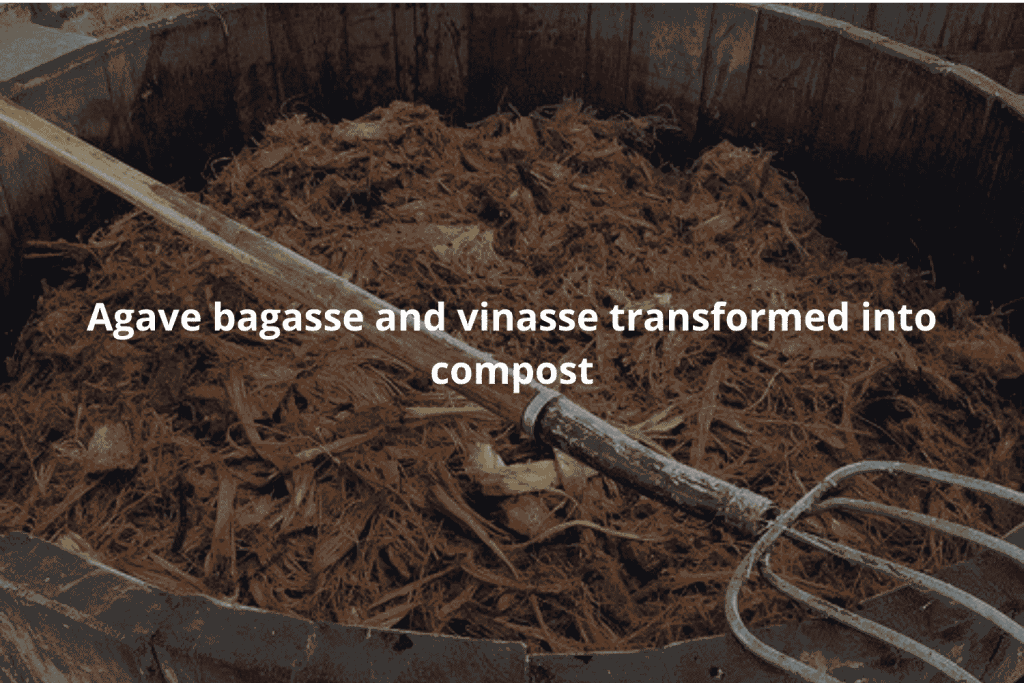
How Are Agave Bagasse and Vinasse Transformed into Compost?
The transformation requires a controlled process. Simply mixing the materials and allowing them to decompose naturally is not enough.
At SUE Tequilana, the process begins with the collection and reception of the materials.
Bagasse is received on processing platforms, while vinasse is stored in collection ponds. The materials are then prepared for incorporation into the composting process.
1. Collection and Reception
The first step consists of receiving the organic waste and verifying its condition.
Bagasse must be inspected to ensure that it does not contain materials unrelated to the process, while vinasse is stored and aerated before being incorporated into the mixture.
2. Mixing the Materials
Agave bagasse and vinasse are combined in an appropriate proportion.
Vinasse can provide moisture to the bagasse, creating favorable conditions for the activity of the microorganisms responsible for decomposition.
3. Forming the Compost Piles
The mixture is arranged into compost piles or windrows.
At this stage, maintaining adequate aeration is important to support microbial activity and prevent conditions that could negatively affect the process.
4. Temperature and Moisture Control
Composting is a biological process that generates heat. For this reason, the temperature and moisture levels of the piles must be monitored.
SUE Tequilana indicates that temperatures during the process can reach approximately 50 to 70°C (122 to 158°F), while moisture must be maintained within appropriate conditions to support microbial activity.
5. Aeration and Turning
The piles are turned periodically to promote oxygen flow and achieve more uniform decomposition.
Turning also helps regulate temperature when necessary.
6. Maturation
After the active decomposition phase, the compost enters a maturation period.
During this stage, the material continues to stabilize until it develops the characteristics required for agricultural use. According to SUE Tequilana, the complete process can take approximately two to four months, depending on conditions and turning frequency.
What Are the Benefits of Reusing Agave Bagasse and Vinasse?
Recovering these byproducts provides benefits that go beyond simply reducing waste.
Recovery of organic matter: Agave bagasse contains a significant amount of organic matter that can be incorporated into transformation processes to produce a useful agricultural product.
Responsible vinasse management: Vinasse requires specialized management due to its characteristics. Incorporating it into controlled processes makes it possible to use this material more responsibly.
Soil regeneration: Compost produced through these processes can add organic matter to the soil and contribute to improving characteristics such as soil structure and moisture retention capacity.
Circular economy: Recovering agave bagasse and vinasse creates a cycle in which byproducts generated by the industry can be transformed into resources intended for agricultural use.
Reduction of industrial waste: Instead of considering these materials only as waste, they can be incorporated into productive processes that give them new value.
Agave Bagasse and Vinasse Recovery at SUE Tequilana
At SUE Tequilana, organic waste recovery is part of an approach focused on sustainable agriculture and the circular economy.
The company has infrastructure designed for receiving and processing agave bagasse, as well as systems for collecting and managing vinasse. Its process includes processing platforms, collection ponds, evaporation and irrigation systems, as well as temperature, moisture, and pH controls throughout the composting process.
SUE Tequilana currently reports infrastructure consisting of six agave bagasse receiving platforms and three vinasse collection ponds, with a reported total capacity of 50,000 m³ for the latter.
In addition to processing these materials, SUE Tequilana provides organic waste collection and storage services, including agave bagasse and vinasse, which are used as raw materials for compost production.
An Opportunity for the Tequila Industry
The growth of the tequila industry also presents a challenge: finding efficient and responsible solutions for the byproducts generated during production.
Agave bagasse and vinasse do not have to represent only a waste management problem. With the appropriate infrastructure, technical knowledge, and controlled processes, they can become resources that contribute to more sustainable agriculture.
Recovering these materials also creates opportunities for collaboration between tequila producers, specialized waste management companies, and agricultural producers.
This allows different sectors to participate in the same resource recovery cycle.
Agave bagasse and vinasse are two of the primary organic byproducts generated by the tequila industry. Although they have different characteristics, both can be incorporated into recovery strategies designed to reduce waste and support a circular economy.
Bagasse can provide the organic matter and structure needed for the composting process, while vinasse can be incorporated in a controlled manner to provide moisture and nutrients.
Through appropriate mixing, aeration, temperature control, moisture management, pH monitoring, and maturation processes, these materials can be transformed into compost intended for agricultural use.
At SUE Tequilana, this model connects the tequila industry with agriculture through the responsible transformation of waste into resources.
Proper management of agave bagasse and vinasse represents an opportunity to reduce the environmental impact of the tequila industry, make better use of available resources, and contribute to soil regeneration.
Discover SUE Tequilana’s solutions for the collection, storage, and transformation of organic waste, and learn how we can help you incorporate these byproducts into a more sustainable resource recovery model.
Explore more articles: